Macros Made Simple
Understand your food. Fuel your body with purpose.
The three macronutrients—protein, carbohydrates, and fats—are the nutrients your body uses for energy, structure, and recovery. Fiber supports digestion and metabolic balance, while micronutrients help keep essential body processes working well.
This page helps you see food with more clarity, so you can make better choices without confusion, fear, or extreme rules.
Clarity Creates Results.

How Macros Work
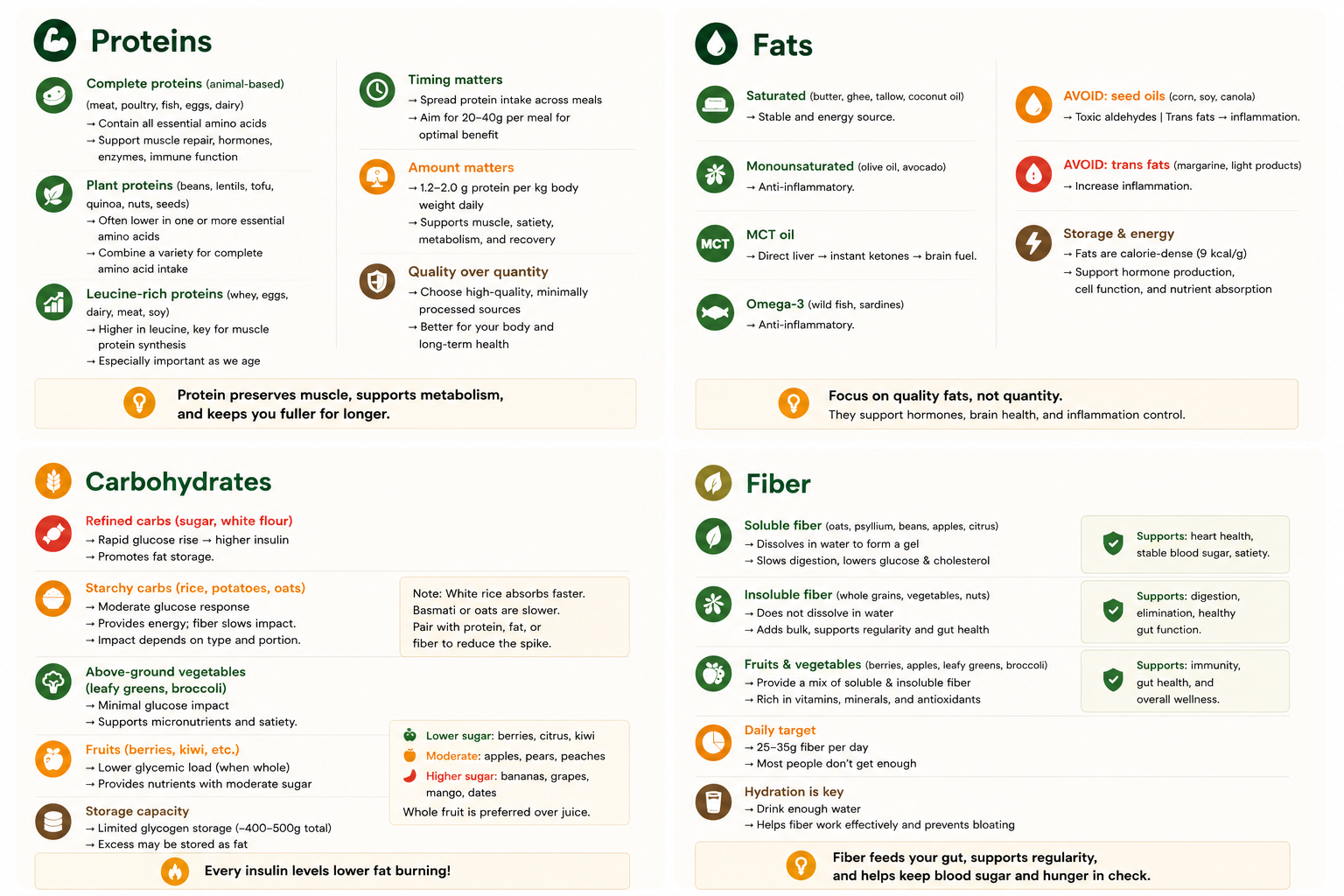
Protein, carbohydrates, and fats all have useful roles. Their effects depend on the food, portion, preparation, meal, activity, health, and your individual response.
ProteinSupports body tissues, enzymes, immune function, and muscle maintenance. Needs vary with age, activity, health, pregnancy, and total food intake. | CarbohydratesProvide energy and can supply fiber and nutrients. Blood-glucose response varies with variety, ripeness, preparation, portion, the rest of the meal, and the person. | FatsHelp form cell membranes, support absorption of fat-soluble vitamins, and provide energy. Favor unsaturated fats as part of an overall balanced pattern. |
Fruit choices do not need a “good sugar” or “bad sugar” ranking. Berries, bananas, and other whole fruits can all fit; portion and personal needs matter.
Fiber & Protein: Everyday Essentials
|
🌿
Fiber & Digestive Health🥗
Fiber supports bowel regularity and fullness and can help support healthy cholesterol and blood-glucose levels. Beans, lentils, vegetables, fruit, whole grains, nuts, and seeds provide different types of fiber. ⚖️
Fiber needs vary with age, sex, and energy intake. U.S. guidance uses about 14 grams per 1,000 calories rather than one number for everyone. 💧
Increase fiber gradually and drink enough fluid for your needs. If fiber repeatedly worsens pain, bloating, constipation, or diarrhea, talk with a qualified healthcare professional. |
💪
Why Protein Matters🧬
Protein supports muscle maintenance and tissue repair and provides amino acids used to make enzymes, hormones, and many other important proteins throughout the body. 🎯
Protein needs vary. About 1.2–2.0 grams per kilogram of body weight per day can be appropriate for many active adults, depending on age, training, energy intake, and health. 🩺
Age, pregnancy, illness, kidney disease, activity, and training can change protein needs. A physician or registered dietitian can help when individual guidance matters. |
Does Eating Fat Make You Fat?
Dietary fat does not automatically become body fat. Fat is energy-dense, so portion size can affect total energy intake, but long-term body-fat change reflects the balance between energy intake and use over time.
Food quality, appetite, activity, sleep, medicines, health conditions, genetics, and environment can also influence weight. No single macronutrient explains every person’s outcome.
Unsaturated fats from foods such as nuts, seeds, fish, avocado, and plant oils can be part of a heart-healthy eating pattern. Your overall pattern matters more than labeling one nutrient as good or bad.

Sources
This platform is built on trusted scientific sources.
- Bikman, B. “Why We Get Sick.” BenBella Books (2020)
- Volek, J.S. & Phinney, S.D. “The Art and Science of Low Carbohydrate Living.” Beyond Obesity LLC (2011)
- Naiman, T. & Shewfelt, W. “The P:E Diet.” (2021)
- Stro, R. & Stro, C. “Dieta Cetogénica / Alimentación Efectiva.” (2019)
- Wolfe, R.R. “Branched-chain amino acids and muscle protein synthesis in humans.” J Int Soc Sports Nutr, 14:30 (2017)
- Ludwig, D.S. et al. “Dietary fat: From foe to friend?” Science 362(6416):764–770 (2018)
- Taubes, G. “Good Calories, Bad Calories.” Anchor Books (2007)